Q: What's ENDA?
A: It's the "Employment Non-Discrimination Act." It's a bill currently before Congress.
Q: What would ENDA do?
A: Extend the protections of title VII to gays, transgendered people and the disabled.
Q: What's title VII?
A: Title VII was the "Equal Pay Act of 1963." It has been subsequently amended, and mostly in liberal directions by the Civil Rights Act of 1991 and the Lily Ledbetter Fair Pay Act of 2009. Here's what the US Code looks like now.
Q: What does it say?
A: Very briefly, it says that you cannot fire, refuse to hire, or generally mistreat employees because of their gender.
Q: Bitchin'. I'm a woman and I've always wanted to be a Catholic priest. I'll start calling lawyers.
A. Not so fast...er...Sister. Religious institutions are exempted.
Q: But what about a Catholic-owned bookstore?
A: They aren't exempted at all. They cannot refuse to hire you based on your gender. Or your not being a Catholic, which would legally get in the way of the priest thing, too, by the way. Or because you're black. Or because you're French.
Q: We even have to hire the French?
A: If they are the most qualified person for the job. Sucks, don't it?
Q: What will happen if ENDA passes?
A: As far as I can tell, it will simply add sexual orientation, gender identity and disability to the list of protected traits. The church won't have to hire gay people, but the bookstore still will if they are the most qualified for the job. Also, it will not allow for "disparate impact" claims, though frankly I don't really see those being relevant to sexuality or gender identity. My guess is that it has some implications for the disability part, though I will have to think that one through.
Q: What's a disparate impact claim?
A: It's a claim that a hiring practice not directly mentioning a protected class still functionally excludes many members of a protected class. For example, if you have a company rule that all employees have to be at least 5"8' then you will exclude many, many women and relatively few men. The Ricci case made famous in the Sotomayor hearings (the one about the firefighter exam that few black people passed) would be an example. The more common firefighter disparate impact case is when firefighters require people to have a high amount of upper body strength, higher than most women have. That's a fun one because it really makes sense to have that.
Q: Can you get fired for "acting Gay"?
A: Oddly enough, that is pretty much already protected as long as you can define "acting gay" as "acting like the opposite gender." Back in 1989, Price Waterhouse denied a woman a partnership, stating that she wasn't "feminine enough" and the SCOTUS made it illegal to discriminate against someone for "not conforming to gender stereotyping." Here's an example of that ruling protecting a flamboyant gay hairdresser.
Q: Do you think "not feminine enough" was code for "lesbian" in that case?
A: I don't know, the SCOTUS didn't seem to take it that way, but I know at least one hairdresser who was protected anyway because of the way they wrote the ruling.
Q: Anyway, what does Title VII mean for religious freedom?
A: It means that Congress has not defined "the freedom to hire, fire and mistreat people based on your religion" as part of religious freedom since at least 1968.
Q: So people who are complaining that ENDA will reduce religious freedom should not be believed?
A: I don't see how anything they are saying is accurate.
Q: Will this get rid of "Don't ask, don't tell"?
A: Nope. The military is exempted.
Q: This is interesting stuff. I want to read more about it.
A: Well, this post is pretty cool.
ADDITIONAL QUESTIONS I WAS ASKED IN THE COMMENTS:
Q: Does it apply to Congress? Many of these kinds of laws don't.
A: As for members of congress themselves, I don't think a claim that one wasn't ELECTED because of a protected trait would fly with the courts.
As for congressional staffers, they are federal employees as far as I know, and sexual orientation has been protected since the Clinton administration and Obama has extended that to gender identity.
As far as people with disabilities are concerned, they are covered by the ADA and the Sections 501 and 505 of the Rehabilitation Act of 1973.
Q: Do you understand what the term "gender identity" means? The definition seems very broad. Are the only possible identities "male" and "female"? How about, "drag queen", "all of the above", or "depends on what time of day we are talking about"?
I was struck by the contrast with the definition of "sexual orientation", which says that you have to be gay, straight, or bi for the law to matter.
"Gender identity" seems much more open ended. If "all of the above" isn't an acceptable identity, why not? And if "all of the above" is an acceptable answer, how does one make sense of the facilities clauses, which seem to assume only two possible "gender identities". (Edited for length, full version is in the comments.)
A: The non-binary genders thing is an excellent question, albeit one that's a little rudely phrased at the beginning. My impression is that a large number of local areas have non-discrimination laws that include transgender folks. I don't recall that the bathroom issue has resulted in a need for transgender bathrooms which is not to say that they don't effectively exist all over the place labeled as "family bathrooms" and usually used by parents and opposite gender children.
Indeed, as I have a husband, I have three bathrooms in my very own house that are not limited to one gender and we have considered putting in a fourth with a Japanese soaking tub.
As for public areas, due to the existence of stalls, I don't care and am not sure what non-discriminatory reason other people have for caring who else is in the bathroom with them, what their philosophy of gender is and least of all what their physical equipment is.
Seems both polite and practical not to speculate on such things.
CC
Showing posts with label CC-written FAQs. Show all posts
Showing posts with label CC-written FAQs. Show all posts
Friday, September 25, 2009


Thursday, July 23, 2009
Giant Gates FAQ
Are you a lawyer?
Hahahaha. No.
Can you give me unofficial legal advice?
Hahahaha. No.
Can you give me unofficial regular advice?
Unless you’re Stephen L. Carter, be nice to the cops anytime you interact with them.
But I am Stephen L. Carter.
*Blush* Will you sign my very dog-eared copy of “The Emperor of Ocean Park?” I love that book.
OK, moving on, what do you think happened between Gates and Officer Crowley?
I think Gates was rude to Officer Crowley, and that pissed Crowley off and Crowley arrested him illegally.
Let’s unpack that. Why do you think Gates was rude to Crowley?
Because even in Gates’ own account he sounds like he was at least snippy. Also because I think most people are pretty cranky after flights from China to Boston.
How long does it take to fly from China to Boston?
It averages 19 hours. Dude was probably exhausted and sore and jetlagged.
Do you think Gates’ perception of racism caused him to act in a more rude way?
I’m sure his knowledge about how black men are often treated by the police upset him even more, but I doubt that was the only factor.
Do you believe that Gates initially refused to show them ID?
Even the police report said that he showed it to them fairly quickly. So if he refused once and agreed a minute later, I don’t see how that should matter.
So you think that Crowley was annoyed because Gates was rude?
Yes.
Do you think Crowley was a racist?
Officer Crowley once gave a black guy mouth-to-mouth. Though there is no definitive proof in this world that somebody ISN’T a racist, I’d say that’s about as close as one can get.
Can one be a non-racist, but still be an arrogant jerk?
Yep.
Why did Gates come outside?
Because the officer asked him to.
When?
Both before he knew Gates was a Harvard professor AND afterwards according to the police report.
Was it OK for the officer to ask him to come outside before he knew he was the legal resident of the house?
I guess so, though I don't see the point. But I don't have a problem with it.
But he also asked Gates to come outside after he knew he was the legal resident of the house, and when Gates had lost his temper?.
Yup
So the officer DID go outside and try to remove himself from the situation?
Sort of. He did go outside, but he doesn't mention having given Gates his Harvard ID back, and he does mention that Gates was still asking for his name and badge number and that he wasn't going to talk to Gates anymore unless Gates followed.
So the officer carried Gates' Harvard ID outside?
Crowley mentions taking it in the report, but not giving it back. I think he took it outside with him for the following reasons:
a. Crowley said he was transmitting information from the ID in his radio call and that he was unable to make his radio call in the house. Unless Crowley memorized the ID, he would still need that to transmit the information that by his own words he was trying to transmit. The simpler explanation is that he took the ID with him.
b. Crowley would likely have written that he handed the ID back to Gates in his report as he is trying to get across the idea that Gates was acting crazily and he was acting reasonably. Taking away a man's Harvard ID and not handing it back is the sort of behavior that provokes people. Crowley does everything he can in the entire rest of the report to emphasize that he wasn't provoking Gates. So the simplest explanation is that if he'd handed the ID back, he would have written it in the report.
Given that, I think what Gates did, follow him outside, is what just about anyone in the situation might have done.
If Crowley gave Gates the ID back and Gates followed him outside for some other reason, how would that change the situation?
Crowley probably would have written about that in his report. But it doesn't change anything legally, it just makes everyone's actions make slightly less sense.
Why did Crowley say that he wanted Gates to step outside the house?
He said that Gates was making so much noise that he couldn’t hear his radio.
How bad could the acoustics in Gates’ house possibly be?
If it is a fancy house with a lot of marble, pretty bad I guess, though the police report makes it sound like the kitchen is right off the front door, which is not typically the design of truly fancy houses.
Shouldn’t Crowley have gone ahead and stepped outside if he knew Gates was living in the house and Crowley wanted to hear his radio?
He sort of did, I just tend to think he just took Gates' ID with him. But his report says he knew other cops were around at that time so he could have turned around and told one of the cops standing in the doorway to radio in and focused on calming Mr. Gates down and apologizing.
Apologizing?
Well, that would be the polite thing to do given the circumstances and how upset Gates was. If this wasn't a false accusation in words, it was one in deeds.
/
Did the officer have any good reason for wanting Gates to come outside after he knew Gates was the legal resident of the house?
Not that I’ve seen in any account of the incident.
But he told Professor Gates that he should come out on the porch if he wanted to continue the conversation anyway?
Yes.
Why would Professor Gates want to continue the conversation?
Because he had asked the officer for his name and badge number and the officer said he wouldn't give them to Gates unless Gates came out on the porch. He claims that he had already given them to Gates twice, but that was still a strange thing to say if he didn't want Gates to come out on the porch.
If Gates was yelling, how was Crowley supposed to give him his name and badge number?
All Massachusetts police are required to carry cards with their names and badge number for just this situation. Crowley apparently chose not to use his.
So what was the effect of Mr. Gates going out on the porch?
It gave the officers a chance to decide he was making a ruckus in a public space and arrest him.
Is it legal to arrest a man for making a ruckus in his own house?
Not usually. If he’s threatening anyone, maybe. If it’s the middle of the night, that’s usually a ticket, not an arrest.
So if Gates had never left the house, they couldn’t have arrested him?
Certainly not legally, and I can’t even think of any trumped-up charges that would have sounded remotely plausible . The usual trumped-up charges for pissing off a police officer are either resisting arrest or disorderly conduct. Someone who isn’t getting arrested and is in his own house really obviously doesn’t qualify for either.
Can one get charged for disorderly conduct for something one does on one's own front porch?
There’s no case law that is perfectly on point. The closest I can find from Massachusetts is that you CAN get charged for it in a public street in the city and you CAN’T in your front yard if your front yard is hidden from the street by a fence. But the basic idea behind disorderly conduct is that it is the sort of behavior that is troublesome or disturbing to the general public.
Were there members of the general public around?
There were half a dozen people watching, including the lady who called in the burglary and the neighbor who gave/sold that photo of Gates to news organizations. My guess is that the folks there were effectively gawkers.
Can you give some more common examples of the sort of behavior that gets disorderly conduct charges?
Public drunkenness, soliciting prostitution, barfights where nobody gets hurt and there’s not much property damage, begging, busking, being a peeping tom. Some of those crimes have more serious versions. The disorderly conduct charge is what the serious charge gets knocked down to if the judge likes you. You know how if you’re speeding and you fight the ticket in court and the judge likes you, he knocks it down to “improper equipment” so the fine is less and you don’t get points on your license? It’s like that.
So basically the disorderly conduct charge is questionable at best?
At best.
Is it possible Gates did something else illegal?
If he did, it would be in the police report and he would have been charged with it. This was not a complicated incident. No real analysis or investigation is likely to have turned up any other charge.
Are people having a lot of trouble with this concept?
Yes, oddly enough. Let’s go through a few examples.
Are you sure Gates didn’t threaten the officer?
Yes. The officer would have mentioned it in a heartbeat and would have charged him for it.
Are you sure Gates didn’t seem like a threat to himself?
Yes. The officer would have mentioned it in the police report and charged him appropriately.
Didn't Gates disobey a police officer?
Disobeying a police officer isn't a crime everywhere, and most of the places it is, it's a crime to get in the way of an investigation or a crime to disobey during an emergency. The reports suggest that Gates did everything the officer asked him to do, albeit slowly and with protest, and things only really got heated after the officer knew Gates lived there and didn't immediately start apologizing and leaving. So the "investigation" part was over. There was no emergency going on, so that requirement doesn't apply either. And again, if the officers could have charged him with that, they likely would have.
Is it possible that the officer felt threatened by Gates?
Anything’s possible, but by the time of the arrest the officer knew Gates was a Harvard professor. And if you’ve seen the infamous photo, you know that Gates was like six inches shorter than the officers at least, much less muscular and much older.
This does not paint a threatening picture. And the officer's feelings aren't relevant to the law as long as he didn't make any threats.
Would a white guy in the same situation have gotten arrested?
Not in my experience. For example, no report I’ve seen suggests Gates cussed at the officer. My brothers (26, with at least a few inches and 75 pounds on Professor Gates) have cussed out police officers before, and the cops usually ignore it.
Speaking of your brothers, have either of them been arrested, and had the cops say something like “the fine will be $40 and we know you can pay for it because we went through your wallet?”
Not that they could recall and they’ve both been arrested many times. As far as I can tell, that was entirely to make Professor Gates feel more violated. But the only version we have of that event is Gates’ so it is possible the police would have an explanation or deny that happened. Also, it’s possible my brothers have never been arrested for a crime so piddling that the fine was only $40.
What’s the worst thing Gates is alleged to have said?
“"I'll speak with your mama outside,"
Does that sound like something a Harvard professor would say?
No, it sounds like a line of dialogue from a Pam Grier movie, which makes me think that it’s what a white guy thinks a black guy might say. I’m not inclined to believe that he really said it.
But what if he did?
Then I’m not signing up for any rhetoric classes he’s teaching, but arresting him was still illegal.
What if he called the cop a racist?
I suspect he probably did. But arresting him was still illegal.
Isn’t insulting a cop illegal?
NO! Tell your friends.
Is there anything he could have said to the cops that would have been illegal?
Physically threatening them. That aside, not that I can think of.
What about crying out that a representative of the government is doing wrong as he arrests you?
It’s pretty much exactly what the founding fathers had in mind with that whole free speech thing.
If Gates had been really sweet and polite, would this have ended easily?
Probably.
If Crowley had started apologizing the moment he saw the Harvard ID, would this have ended easily?
At worst, there would have been a complaint to Crowley's department, which would have been "investigated" then ignored. Complaints about cops that don't involve violence are usually not taken particularly seriously.
Was it a good idea for Gates to be all Al-Sharptony with the police?
Well, first of all, that he was Al Sharptony is my assumption, not a known fact. But while it gave Gates an unpleasant afternoon, it has raised a lot of awareness and gotten people talking about the fact that this stuff can happen to people who really haven't done anything wrong. And hey, maybe the next time the police are thinking about hassling a black guy, they will wonder if he's Cornel West and decide it isn't worth the trouble.
Why do you mostly use the police report rather than mostly using Gates' version?
Because I ultimately come to the conclusion that Crowley was in the wrong and I can do so using his own account and the arrest he made and the relevant statutes and caselaw. Being able to say "Even using Crowley's version of what happened, he was still in the wrong makes a stronger argument.
If Gates was really rude and Crowley arrested him for a trumped-up charge, then why is Crowley in the wrong and Gates not?
Because "always be polite to the police" is not a requirement to be an American citizen. "Don't make illegal arrests" IS a requirement to be a police officer.
CC
EDIT: Robin pointed out in the comments that Crowley had asked Gates to come outside BEFORE he knew he was the legal resident of the house as well. I added some clarifications on that point.
EDIT II: I've tweaked several sections about Gates coming outside and his potential reasons for doing so and I added two extra questions to the end, one that I was asked over email and one that clarifies another point.
EDIT III: PG mentioned in the comments that whether or not Crowley kept the Harvard ID, Gates still didn't have his name and badge number and Crowley made clear that he wasn't getting it again until Gates came out on the porch. I recalled that Fairfax County police are required to carry business cards with their name and badge number. I wondered if this was true of Massachusetts police. Yes, it is. So Crowley's explanation that he COULDN'T give Gates his name and badge number because Gates was yelling so loud is also bull.
Sources:
Mostly The Police report Crowley wrote
The Laws of the Commonwealth of Massachusetts though I mostly looked them up in Lexis-Nexis rather than using that source.
Orbitz.com for the time it takes to fly from China to Boston.
This New York Times Article and its interview with Crowley
I didn't really use Gates' version much for reasons I explain above. But it is here.
Hahahaha. No.
Can you give me unofficial legal advice?
Hahahaha. No.
Can you give me unofficial regular advice?
Unless you’re Stephen L. Carter, be nice to the cops anytime you interact with them.
But I am Stephen L. Carter.
*Blush* Will you sign my very dog-eared copy of “The Emperor of Ocean Park?” I love that book.
OK, moving on, what do you think happened between Gates and Officer Crowley?
I think Gates was rude to Officer Crowley, and that pissed Crowley off and Crowley arrested him illegally.
Let’s unpack that. Why do you think Gates was rude to Crowley?
Because even in Gates’ own account he sounds like he was at least snippy. Also because I think most people are pretty cranky after flights from China to Boston.
How long does it take to fly from China to Boston?
It averages 19 hours. Dude was probably exhausted and sore and jetlagged.
Do you think Gates’ perception of racism caused him to act in a more rude way?
I’m sure his knowledge about how black men are often treated by the police upset him even more, but I doubt that was the only factor.
Do you believe that Gates initially refused to show them ID?
Even the police report said that he showed it to them fairly quickly. So if he refused once and agreed a minute later, I don’t see how that should matter.
So you think that Crowley was annoyed because Gates was rude?
Yes.
Do you think Crowley was a racist?
Officer Crowley once gave a black guy mouth-to-mouth. Though there is no definitive proof in this world that somebody ISN’T a racist, I’d say that’s about as close as one can get.
Can one be a non-racist, but still be an arrogant jerk?
Yep.
Why did Gates come outside?
Because the officer asked him to.
When?
Both before he knew Gates was a Harvard professor AND afterwards according to the police report.
Was it OK for the officer to ask him to come outside before he knew he was the legal resident of the house?
I guess so, though I don't see the point. But I don't have a problem with it.
But he also asked Gates to come outside after he knew he was the legal resident of the house, and when Gates had lost his temper?.
Yup
So the officer DID go outside and try to remove himself from the situation?
Sort of. He did go outside, but he doesn't mention having given Gates his Harvard ID back, and he does mention that Gates was still asking for his name and badge number and that he wasn't going to talk to Gates anymore unless Gates followed.
So the officer carried Gates' Harvard ID outside?
Crowley mentions taking it in the report, but not giving it back. I think he took it outside with him for the following reasons:
a. Crowley said he was transmitting information from the ID in his radio call and that he was unable to make his radio call in the house. Unless Crowley memorized the ID, he would still need that to transmit the information that by his own words he was trying to transmit. The simpler explanation is that he took the ID with him.
b. Crowley would likely have written that he handed the ID back to Gates in his report as he is trying to get across the idea that Gates was acting crazily and he was acting reasonably. Taking away a man's Harvard ID and not handing it back is the sort of behavior that provokes people. Crowley does everything he can in the entire rest of the report to emphasize that he wasn't provoking Gates. So the simplest explanation is that if he'd handed the ID back, he would have written it in the report.
Given that, I think what Gates did, follow him outside, is what just about anyone in the situation might have done.
If Crowley gave Gates the ID back and Gates followed him outside for some other reason, how would that change the situation?
Crowley probably would have written about that in his report. But it doesn't change anything legally, it just makes everyone's actions make slightly less sense.
Why did Crowley say that he wanted Gates to step outside the house?
He said that Gates was making so much noise that he couldn’t hear his radio.
How bad could the acoustics in Gates’ house possibly be?
If it is a fancy house with a lot of marble, pretty bad I guess, though the police report makes it sound like the kitchen is right off the front door, which is not typically the design of truly fancy houses.
Shouldn’t Crowley have gone ahead and stepped outside if he knew Gates was living in the house and Crowley wanted to hear his radio?
He sort of did, I just tend to think he just took Gates' ID with him. But his report says he knew other cops were around at that time so he could have turned around and told one of the cops standing in the doorway to radio in and focused on calming Mr. Gates down and apologizing.
Apologizing?
Well, that would be the polite thing to do given the circumstances and how upset Gates was. If this wasn't a false accusation in words, it was one in deeds.
/
Did the officer have any good reason for wanting Gates to come outside after he knew Gates was the legal resident of the house?
Not that I’ve seen in any account of the incident.
But he told Professor Gates that he should come out on the porch if he wanted to continue the conversation anyway?
Yes.
Why would Professor Gates want to continue the conversation?
Because he had asked the officer for his name and badge number and the officer said he wouldn't give them to Gates unless Gates came out on the porch. He claims that he had already given them to Gates twice, but that was still a strange thing to say if he didn't want Gates to come out on the porch.
If Gates was yelling, how was Crowley supposed to give him his name and badge number?
All Massachusetts police are required to carry cards with their names and badge number for just this situation. Crowley apparently chose not to use his.
So what was the effect of Mr. Gates going out on the porch?
It gave the officers a chance to decide he was making a ruckus in a public space and arrest him.
Is it legal to arrest a man for making a ruckus in his own house?
Not usually. If he’s threatening anyone, maybe. If it’s the middle of the night, that’s usually a ticket, not an arrest.
So if Gates had never left the house, they couldn’t have arrested him?
Certainly not legally, and I can’t even think of any trumped-up charges that would have sounded remotely plausible . The usual trumped-up charges for pissing off a police officer are either resisting arrest or disorderly conduct. Someone who isn’t getting arrested and is in his own house really obviously doesn’t qualify for either.
Can one get charged for disorderly conduct for something one does on one's own front porch?
There’s no case law that is perfectly on point. The closest I can find from Massachusetts is that you CAN get charged for it in a public street in the city and you CAN’T in your front yard if your front yard is hidden from the street by a fence. But the basic idea behind disorderly conduct is that it is the sort of behavior that is troublesome or disturbing to the general public.
Were there members of the general public around?
There were half a dozen people watching, including the lady who called in the burglary and the neighbor who gave/sold that photo of Gates to news organizations. My guess is that the folks there were effectively gawkers.
Can you give some more common examples of the sort of behavior that gets disorderly conduct charges?
Public drunkenness, soliciting prostitution, barfights where nobody gets hurt and there’s not much property damage, begging, busking, being a peeping tom. Some of those crimes have more serious versions. The disorderly conduct charge is what the serious charge gets knocked down to if the judge likes you. You know how if you’re speeding and you fight the ticket in court and the judge likes you, he knocks it down to “improper equipment” so the fine is less and you don’t get points on your license? It’s like that.
So basically the disorderly conduct charge is questionable at best?
At best.
Is it possible Gates did something else illegal?
If he did, it would be in the police report and he would have been charged with it. This was not a complicated incident. No real analysis or investigation is likely to have turned up any other charge.
Are people having a lot of trouble with this concept?
Yes, oddly enough. Let’s go through a few examples.
Are you sure Gates didn’t threaten the officer?
Yes. The officer would have mentioned it in a heartbeat and would have charged him for it.
Are you sure Gates didn’t seem like a threat to himself?
Yes. The officer would have mentioned it in the police report and charged him appropriately.
Didn't Gates disobey a police officer?
Disobeying a police officer isn't a crime everywhere, and most of the places it is, it's a crime to get in the way of an investigation or a crime to disobey during an emergency. The reports suggest that Gates did everything the officer asked him to do, albeit slowly and with protest, and things only really got heated after the officer knew Gates lived there and didn't immediately start apologizing and leaving. So the "investigation" part was over. There was no emergency going on, so that requirement doesn't apply either. And again, if the officers could have charged him with that, they likely would have.
Is it possible that the officer felt threatened by Gates?
Anything’s possible, but by the time of the arrest the officer knew Gates was a Harvard professor. And if you’ve seen the infamous photo, you know that Gates was like six inches shorter than the officers at least, much less muscular and much older.
This does not paint a threatening picture. And the officer's feelings aren't relevant to the law as long as he didn't make any threats.
Would a white guy in the same situation have gotten arrested?
Not in my experience. For example, no report I’ve seen suggests Gates cussed at the officer. My brothers (26, with at least a few inches and 75 pounds on Professor Gates) have cussed out police officers before, and the cops usually ignore it.
Speaking of your brothers, have either of them been arrested, and had the cops say something like “the fine will be $40 and we know you can pay for it because we went through your wallet?”
Not that they could recall and they’ve both been arrested many times. As far as I can tell, that was entirely to make Professor Gates feel more violated. But the only version we have of that event is Gates’ so it is possible the police would have an explanation or deny that happened. Also, it’s possible my brothers have never been arrested for a crime so piddling that the fine was only $40.
What’s the worst thing Gates is alleged to have said?
“"I'll speak with your mama outside,"
Does that sound like something a Harvard professor would say?
No, it sounds like a line of dialogue from a Pam Grier movie, which makes me think that it’s what a white guy thinks a black guy might say. I’m not inclined to believe that he really said it.
But what if he did?
Then I’m not signing up for any rhetoric classes he’s teaching, but arresting him was still illegal.
What if he called the cop a racist?
I suspect he probably did. But arresting him was still illegal.
Isn’t insulting a cop illegal?
NO! Tell your friends.
Is there anything he could have said to the cops that would have been illegal?
Physically threatening them. That aside, not that I can think of.
What about crying out that a representative of the government is doing wrong as he arrests you?
It’s pretty much exactly what the founding fathers had in mind with that whole free speech thing.
If Gates had been really sweet and polite, would this have ended easily?
Probably.
If Crowley had started apologizing the moment he saw the Harvard ID, would this have ended easily?
At worst, there would have been a complaint to Crowley's department, which would have been "investigated" then ignored. Complaints about cops that don't involve violence are usually not taken particularly seriously.
Was it a good idea for Gates to be all Al-Sharptony with the police?
Well, first of all, that he was Al Sharptony is my assumption, not a known fact. But while it gave Gates an unpleasant afternoon, it has raised a lot of awareness and gotten people talking about the fact that this stuff can happen to people who really haven't done anything wrong. And hey, maybe the next time the police are thinking about hassling a black guy, they will wonder if he's Cornel West and decide it isn't worth the trouble.
Why do you mostly use the police report rather than mostly using Gates' version?
Because I ultimately come to the conclusion that Crowley was in the wrong and I can do so using his own account and the arrest he made and the relevant statutes and caselaw. Being able to say "Even using Crowley's version of what happened, he was still in the wrong makes a stronger argument.
If Gates was really rude and Crowley arrested him for a trumped-up charge, then why is Crowley in the wrong and Gates not?
Because "always be polite to the police" is not a requirement to be an American citizen. "Don't make illegal arrests" IS a requirement to be a police officer.
CC
EDIT: Robin pointed out in the comments that Crowley had asked Gates to come outside BEFORE he knew he was the legal resident of the house as well. I added some clarifications on that point.
EDIT II: I've tweaked several sections about Gates coming outside and his potential reasons for doing so and I added two extra questions to the end, one that I was asked over email and one that clarifies another point.
EDIT III: PG mentioned in the comments that whether or not Crowley kept the Harvard ID, Gates still didn't have his name and badge number and Crowley made clear that he wasn't getting it again until Gates came out on the porch. I recalled that Fairfax County police are required to carry business cards with their name and badge number. I wondered if this was true of Massachusetts police. Yes, it is. So Crowley's explanation that he COULDN'T give Gates his name and badge number because Gates was yelling so loud is also bull.
Sources:
Mostly The Police report Crowley wrote
The Laws of the Commonwealth of Massachusetts though I mostly looked them up in Lexis-Nexis rather than using that source.
Orbitz.com for the time it takes to fly from China to Boston.
This New York Times Article and its interview with Crowley
I didn't really use Gates' version much for reasons I explain above. But it is here.
Monday, June 29, 2009
Quick FAQ on the recent Supreme court decisions
(Disclaimer: I'm not a lawyer, some weeks I'm barely a law student. Recently, I'm knee deep in a paper on cyberharassment by third parties. But I have been paying attention to the recent batch of SCOTUS decisions and people keep asking me questions about them. And we all know I like to write FAQs.)
Q: Why have there been so many SCOTUS decisions recently?
A: There haven't been all that many, but the ones that are coming down are the most famous. Important/weird cases tend to get decided at the end of the term because the SCOTUS takes extra time to argue them.
Q. Is it just me, or have the SCOTUS decisions recently been less crazytown than usual?
A. The Osborne decision notwithstanding, yes, the decisions have been pretty reasonable.
Q: Why?
A: I credit the Sotomayor nomination. After all the crap conservatives gave Sotomayor for suggesting that a court might need diversity of background to make decisions that really took into account the perspectives of diverse parties, they couldn't go and prove her point by deciding that school officials making a 13-year-old get naked was really no big deal.
Q: What was up with Thomas' opinion in that case?
A: He mostly went off an old decision that said that a girl who was suspected of smoking in the bathroom could have her purse searched.
Q: So we should totally pop champagne about that case, right?
A: Eh. First off, without Sotomayor, my guess is it might have come out the other way. The transcript of the arguments really gives the impression that the Justices don't fucking get what the problem with making a thirteen year old strip because she might be carrying advil. Justice Kennedy was like "Is the nature of the drug irrelevant? What if it was meth to be consumed at noon?" and Souter thinks violating the student's privacy is less important that preventing accidental panty meth poisonings. (That's a paraphrase.)
Q: But the court ultimately overcame their fear of panty meth. So good, right?
A. Again, Eh. Ginsburg and Stevens were the only ones who thought the school district should be liable for the girl's emotional distress. The other ones said that making a 13 year old get naked so there could be a search for Advil was insufficiently obviously wrong for it to be actionable.
Q: Is it obviously wrong?
A. If Scalia and Ginsburg and Souter and Kennedy agree on something, it's usually pretty obvious. I would totally have voted with Ginsburg and Stevens.
Q: What about the case about the voting rights act?
A: This is an opinion that I haven't read, but my impression is that the court wanted to find for the municipality with making the smallest possible impact on the voting rights act.
Q. Why? I would think that the court would be overturn the voting rights act since doing so is the properly Crazytown decision to make?
A: Right, but again, overturning the voting rights act would make Sotomayor's confirmation a lot easier.
Q. I want some crazy. What does Justice Thomas think?
A: He thinks that striking down the Voting Rights act would be not a "sign of defeat" but an "acknowledgement of victory," the implication being that, ya know, Racism is over.
Q. Oooh. That's good crazy.
A. It's ok. I like Scalia's brand of crazy better. He's crazy in a your-Crazy-Uncle-Harry-who-makes-Thanksgiving-fun sort of way. Thomas is more like one of those ranting dudes in a bar who won't shut up about how the Bears are the best team ever in absence of any evidence that this is the case. More importantly to me, you normally can get why Scalia feels the way he does even when you disagree which is usually and Thomas is a much greater believer in cherrypicking the one case that's with him and ignoring everything else. And Scalia is snarky and loves to talk to the press enough that he sometimes has to recuse himself because he's already talked about the case before it's argued. He's loads of fun. I'm tempted to name a World of Warcraft character after him.
Q. Now what about the firemen?
A. The Ricci decision is another one I haven't read, though I've read a fair amount about it. One thing I'd like to know that I haven't seen is whether anybody has figured out WHY the African Americans flunked the test. Early standardized tests were specifically designed to keep New York Jews out of the Ivy League and had lots of questions like "Ballanchine:Ballet::Frank Gehrey:__________" that people from poorer backgrounds weren't supposed to be able to answer.
Q: How did that work out?
A: A New York Jew named Stanley Kaplan got very rich.
Q: So standardized tests can be racist?
A: Effectively, yes, but I don't know that this one was. I'd like to know if it was.
Q: Anyway, does Sotomayor's decision show she's outside the mainstream?
A: Not from what I've seen. She followed precedent, the SCOTUS just changed the law.
Q: Will the conservative pundits understand that distinction?
A: If they do, they won't let on.
Q: So what about the case about the Forensic Experts?
A: Crazy Uncle Scalia wrote an opinion that the reports of crime scene lab techs were functionally witnesses for the prosecution, and that the lab techs needed to be available for cross examination.
Q: What's the upshot?
A. Well, running a crime lab just got more expensive since techs will be spending a lot more time in court so the crime labs will need to hire more of them to get through the same number of cases. On the upside, people, with excellent reason, have become really skeptical of the work of forensics experts and this might actually restore their faith. And my undergraduate institution, which needs all the help in can get, has a forensic science program so the new lab tech jobs counts as a win for me personally there, too.
Q: What's weird about this case?
A: I think it by implication concedes that crime techs are not independent and are functionally working for the prosecution, something that has been fairly obvious to anyone who pays attention to this stuff for some time, but that is not typically formally admitted.
Q: Overall picture?
A: Obama should nominate Sotomayor near the end of every term. And anyone who loves law should read Souter's dissent is Osbourne, which includes a beautifully written, thoughtful, jurisprudential discussion that is not precisely on point, but still great.
Q: Why have there been so many SCOTUS decisions recently?
A: There haven't been all that many, but the ones that are coming down are the most famous. Important/weird cases tend to get decided at the end of the term because the SCOTUS takes extra time to argue them.
Q. Is it just me, or have the SCOTUS decisions recently been less crazytown than usual?
A. The Osborne decision notwithstanding, yes, the decisions have been pretty reasonable.
Q: Why?
A: I credit the Sotomayor nomination. After all the crap conservatives gave Sotomayor for suggesting that a court might need diversity of background to make decisions that really took into account the perspectives of diverse parties, they couldn't go and prove her point by deciding that school officials making a 13-year-old get naked was really no big deal.
Q: What was up with Thomas' opinion in that case?
A: He mostly went off an old decision that said that a girl who was suspected of smoking in the bathroom could have her purse searched.
Q: So we should totally pop champagne about that case, right?
A: Eh. First off, without Sotomayor, my guess is it might have come out the other way. The transcript of the arguments really gives the impression that the Justices don't fucking get what the problem with making a thirteen year old strip because she might be carrying advil. Justice Kennedy was like "Is the nature of the drug irrelevant? What if it was meth to be consumed at noon?" and Souter thinks violating the student's privacy is less important that preventing accidental panty meth poisonings. (That's a paraphrase.)
Q: But the court ultimately overcame their fear of panty meth. So good, right?
A. Again, Eh. Ginsburg and Stevens were the only ones who thought the school district should be liable for the girl's emotional distress. The other ones said that making a 13 year old get naked so there could be a search for Advil was insufficiently obviously wrong for it to be actionable.
Q: Is it obviously wrong?
A. If Scalia and Ginsburg and Souter and Kennedy agree on something, it's usually pretty obvious. I would totally have voted with Ginsburg and Stevens.
Q: What about the case about the voting rights act?
A: This is an opinion that I haven't read, but my impression is that the court wanted to find for the municipality with making the smallest possible impact on the voting rights act.
Q. Why? I would think that the court would be overturn the voting rights act since doing so is the properly Crazytown decision to make?
A: Right, but again, overturning the voting rights act would make Sotomayor's confirmation a lot easier.
Q. I want some crazy. What does Justice Thomas think?
A: He thinks that striking down the Voting Rights act would be not a "sign of defeat" but an "acknowledgement of victory," the implication being that, ya know, Racism is over.
Q. Oooh. That's good crazy.
A. It's ok. I like Scalia's brand of crazy better. He's crazy in a your-Crazy-Uncle-Harry-who-makes-Thanksgiving-fun sort of way. Thomas is more like one of those ranting dudes in a bar who won't shut up about how the Bears are the best team ever in absence of any evidence that this is the case. More importantly to me, you normally can get why Scalia feels the way he does even when you disagree which is usually and Thomas is a much greater believer in cherrypicking the one case that's with him and ignoring everything else. And Scalia is snarky and loves to talk to the press enough that he sometimes has to recuse himself because he's already talked about the case before it's argued. He's loads of fun. I'm tempted to name a World of Warcraft character after him.
Q. Now what about the firemen?
A. The Ricci decision is another one I haven't read, though I've read a fair amount about it. One thing I'd like to know that I haven't seen is whether anybody has figured out WHY the African Americans flunked the test. Early standardized tests were specifically designed to keep New York Jews out of the Ivy League and had lots of questions like "Ballanchine:Ballet::Frank Gehrey:__________" that people from poorer backgrounds weren't supposed to be able to answer.
Q: How did that work out?
A: A New York Jew named Stanley Kaplan got very rich.
Q: So standardized tests can be racist?
A: Effectively, yes, but I don't know that this one was. I'd like to know if it was.
Q: Anyway, does Sotomayor's decision show she's outside the mainstream?
A: Not from what I've seen. She followed precedent, the SCOTUS just changed the law.
Q: Will the conservative pundits understand that distinction?
A: If they do, they won't let on.
Q: So what about the case about the Forensic Experts?
A: Crazy Uncle Scalia wrote an opinion that the reports of crime scene lab techs were functionally witnesses for the prosecution, and that the lab techs needed to be available for cross examination.
Q: What's the upshot?
A. Well, running a crime lab just got more expensive since techs will be spending a lot more time in court so the crime labs will need to hire more of them to get through the same number of cases. On the upside, people, with excellent reason, have become really skeptical of the work of forensics experts and this might actually restore their faith. And my undergraduate institution, which needs all the help in can get, has a forensic science program so the new lab tech jobs counts as a win for me personally there, too.
Q: What's weird about this case?
A: I think it by implication concedes that crime techs are not independent and are functionally working for the prosecution, something that has been fairly obvious to anyone who pays attention to this stuff for some time, but that is not typically formally admitted.
Q: Overall picture?
A: Obama should nominate Sotomayor near the end of every term. And anyone who loves law should read Souter's dissent is Osbourne, which includes a beautifully written, thoughtful, jurisprudential discussion that is not precisely on point, but still great.
Tuesday, October 03, 2006
Foley FAQ
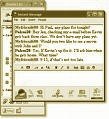
Because a lot of people seem confused about a few of the facts of this case.
Q. I've seen some of the emails and they look weird, but not that bad. What's all the fuss about?
A. There were two different sets of communications. There are some weird-sounding but tame emails where the kid isn't into it from 2005 and some really raunchy IMs where another kid was into it* from 2003. Especially at the beginning, news stories were only quoting the emails which had a lot of people wondering what the fuss was about. Anyway, the non-work safe IMs are here and a billion other places. The tamer emails are quoted lots of news stories. Here's the blog where they first appeared.
Q. Were these kids minors? What are the age of consent implications?
A. According to the actual laws quoted on Ageofconsent.com, the age of consent in DC is 16. (DC does have a four-year window, as has been widely reported, but the "Child' means a person who has not yet attained the age of 16 years" bit says to me that the need for the window ends at 15.) As far as I've heard all of these kids were 16. However, the kid he was emailing with was in Louisiana, and there the age of consent is 17 and homosexual sex is illegal. The sodomy law may be irrelevant as the two didn't actually ever get together. Of course, there are laws about coming on to minors on the internet, some of them written by Foley himself as head of the committee on such things. I didn't find the full text of those in a quick search, but it's pretty safe to assume Foley broke them I'd say.
Q. Does this sound like a setup to you? How can a man remain in congress for over a decade and yet be so indiscreet?
A. The whole thing sounded fishy to me in the beginning, I admit. I wondered if there was some sort of sting. Having read up on it, I'm ready to concede that Foley was just stupid. He was likely too impressed with his own power and in the case of the IMs probably assumed the kid's encouragement meant the kid was gay, too, and thus unlikely to rat him out. Foley's checking himself into rehab may be a peice of the puzzle, too. It, of course, excuses nothing if he was drunk when he did some of this stuff, but it does suggest why he might have gone about it so sloppily.
Q. So is there any proof that the IMs are real?
A. I haven't heard of any. That said, it's probably unAmerican to take Foley's quick resignation as proof, but it might be reasonable to do so in this case. IMHO, he would have fought it if only the weird-sounding emails were real.
Q. So House leadership has known for HOW long?
A. Their claim is that they found out about the weird-sounding emails last year and told Foley to cut it out, but that they didn't know about the much freakier IMs from several years ago. This actually sounds pretty believable to me. Yes, there are reports that Republican staffers "warned" pages about Foley, but in the abscence of other evidence, I'm quicker to believe that these warnings were more like "Teenage boys should stay away from the gay guy" than "we have actual evidence Foley has done something wrong."
That said, Foley's ex-opponent in Florida is a billionaire and even in a 54-percent-Bush-voting-district, it's easier to hold onto a seat than win it again. So the coverup strategy is at least possible. But I'd still say from what I've heard the House leadership's side is no less believable.
Q. How did this story break?
A. The teenager who was emailed told his mother, who sent copies of the emails to a couple of different news sources around Florida. Then the teenager backed out and refused to corroborate anything. So the newspapers were stuck with a story with no corroborating sources and emails that were weird, but not explicit. The Miami Herald sent the emails to the FBI. Eventually, an anonymous person opened a blog called "Stop Sex Predators" and posted the emails. You can judge for yourself on the blog, but it looks to me like it was pretty obviously opened soley for the purpose of releasing the emails. Wonkette picked up the story, ABC news reported that Wonkette was reporting it. (You will note that up until now, we're only talking about the slightly creepy emails. As the first stories were only about them, that set up a lot of the confusion I alluded to in the first question.)
Anyway, when ABC news started reporting the emails, somebody sent them the raunchier IM transcript.
Q: Anything else?
A: Wonkette says it best: The question that remains: Who sent the emails to Stop Sex Predators? Someone made sure this all broke as October began — someone way too smart and Machiavellian to be an actual employee of the Democratic Party.
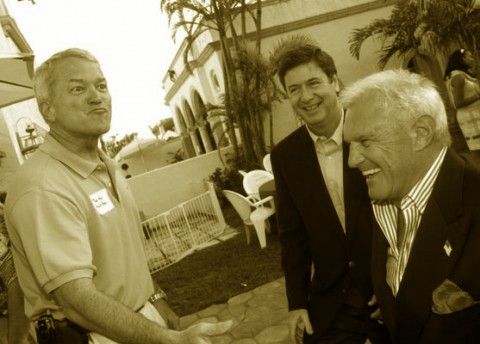
Q: Oh, and could you please provide a picture of Foley with George Allen?
A: Oh, happily, but I'm sepia-toning it first.
CC
*Naturally it's still abusive when the teenager is into it. And Foley clearly starts the sex talk.
Subscribe to:
Posts (Atom)